Sunday, October 11, 2015

Remaking Learning at Perry High School's Library


My ex-brother in law works at Google Pittsburgh. Let's call him BIL. BIL gets to work each morning and is greeted by a hearty breakfast cooked for him by a gourment chef. The meals are healthy, locally sourced and delicious, with Google's own egg-laying chickens and honey-bearing bees on the roof. If BIL doesn't want what the chef cooked that day, he can go to one of a few stocked mini-food bars, where there are cold drinks, coffee and tea, piles of fresh fruit and islands which hold tall glass containers of candy and snacks.

If BIL needs a break, he can go to the music room, sit down at the keyboard or pick up an instrument and jam with his friends. He can go to the video game room and relax, shoot some bad guys in a bean bag chair, and let his mind go in a differnent way for awhile. He can untangle the problem he was working on while playing, or chat with a coworker. If that doesn't work-- he can go to the massage room for a nice massage. At Google Pittsburgh, there is a net that hangs over part of the work space. It has large pillows in it. You can take a book and lie in the net, spider-like, dangling 30 feet above everybody else, and rest. There is a beautiful gourmet dinner for you waiting-- and you don't have go home until you want to. What a great way to work! What a great way for a company to treat valued employees! What a terrific way to encourage mind-body connection-and help good thinkers continue to think, collaborate, engage, create!

Wouldn't it be nice for school children to be treated like the computer software engineers at Google Pittsburgh? Our world certainly needs kids' brain power at least as much as it needs BIL's. It's not just the beautiful food and massages I'm talking about. What I find most important about Google's approach is their willingness to create an environment in which people can back up, rest, relax, and engage with others at work. I believe relationships and engaging with others is the way to truly be productive in the 21st century.

So let's do that! Let's remake what learning looks like at our schools! And guess what? It seems we may have some catching up to do.

A group of folks in Pittsburgh have been thinking about project-based, hands-on, creative, engaging, collaborative type education for a long time. Almost a decade ago, a group of smart folks got together to think about how the internet age had changed the way kids thought and learned. They wanted a new way to engage kids. They began to meet at Pamela's for pancakes (proving as always that where there is food, there is good thinking) and brain storming about how to better meet the needs of a different type of learner-- one who didn't want to be lectured to-- who wanted to make, create, do, be something-- who demanded to be heard, listened to, who wanted to move around, build stuff, learn from other kids, find their own ways. A kid who needed new pathways to excel. This group became Kids+Creativity--thought leaders who wanted to improve how kids learned in and around Pittsburgh.

Almost 10 years later, the group has become Remake Learning. Their mission statement reads:

Representing more than 200 organizations, Remake Learning is a professional network of schools, museums, libraries, afterschool programs, community centers, higher education institutions, education technology companies, philanthropies, and civic leaders working together to inspire a generation of lifelong learners in Pittsburgh, West Virginia, and beyond.
Pretty damn cool, and pretty impressive. Like I said--Pamela's pancakes will take you a long way. But-- all kidding aside-- when the right, creative people are in the room-- awesome things happen. 

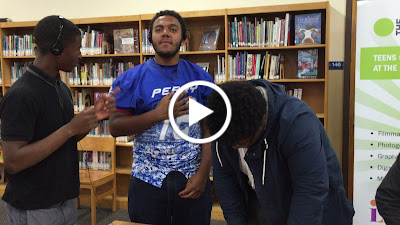
And that's what the video you watched at the beginning of this blog post showed, too-- awesome things happening in Perry's Library, because great people came together. Daniel Brown, one of the Teen Librarians from the Allegheny branch of the Carnegie Library of Pittsburgh, brought music technology from The Labs, a technology and arts Maker Space they have at their branch. Five volunteer/therapy dog owners from Animal Friends brought their dogs. And our kids-- our kids. Some of our music students prepared instrumental and vocal pieces to perform. And they were brilliant.

That gorgeous stew of folks remade learning for Friday, October 8th. We had a veritable salon in the Library of kids, mixing and experimenting with sound and music technology. We had others listening to peers perform, gaining new knowlege and respect for North Side kids across social groups, academic abilities, races. There were the dogs, which brought sparkle, calm, joy and interest to the whole room. The best thing? The creative, artistic, safe, engaging and positive place this group of people (and beasts) made the Library into. And guess what?! WPXI's Courtney Brennan came to film our event!! We were so pleased that they cared about sharing good news out of a pubic school!


Dogs and music combine for touching moments for students at...

Here are ways my learning community and I are working to remake learning in Perry's Library: my Journalism class is working with Steeltown Entertainment to teach our kids film making skills. The kids wrote essays about their lives on the North Side, some excerpts of which I published here. Based on the power of their published work, the kids have been invited to perform at the City of Asylum on October 23rd, at 813 Sampsonia Way on the North Side from 7-9PM.

We begin work on framing our essays into spoken word performances with the music and instrumental teachers and their students this week. We are taking our kids and following their interest and then chaperoning them and their work out into the wider world. What a great way to learn! What a great way to teach!! Our kids might be getting ready for you, Google Pittsburgh! Watch out! Make room in that hanging net! We have collaborative meetings to schedule with you!




READ REMAKE LEARNING'S PLAYBOOK: http://remakelearning.org/playbook/


Sunday, October 4, 2015

North Side Voices


Growing up on the northside is not very easy
there was a lot of shootings everyday especially when i was a little kid

one day me, my two brothers and my older sister was coming from the park
they had me in a stroller and my sister was strollering me

they started shooting

my brothers and sister started running

they dropped the stroller while i was still in there

and left me

in the middle

of the street

five minutes after   that    my mom came    and got me
i could of   got   shot but thank god i did not
we moved off of the northside after a while
and moved to the southside
there were shootings over there too
but we moved from over there back to the northside
on woodland ave as they like to call it woodland block
when we first moved on that street there was a shooting
cause of the northview and manchester beef
the shootings stopped for a couple of days and we all went back to having fun
you know doin what teenagers do
then i hear on the news
that a fourteen year old boy died

I am teaching a Creative Nonfiction class. My kids are writing personal narratives about growing up on the North Side of Pittsburgh. I have to grade them this weekend, which means today, because I put it off yesterday. The stack of papers to be graded were glowing with a kind of negative energy in my mind, like Kryptonite. I was avoiding them mightily. I have to face them.


I'm stronger now. I saw friends last night. I slept long. I'm fresher, better today. 

But I'm still afraid, because the pain of reading my kids' experience, of facing the realities they are forced to live, is makes my blood stop and the bile rise in my throat. Tears prick thinking about it.


Growing up on the North Side is not the easiest thing in the world. But growing up as an African American homosexual male on the North Side isn't any easier. You can often find it one of the harder things you ever do. You are already a minority being African American, but then being homosexual puts you at the bottom of the totem pole. Most people find homosexual men loud, flamboyant, blunt, and too gay for their own good. Most of us are actually chill. But because they don't see that side of the community, we are not set aside from the stereotypical homsexual men in the world. I found many times in my life where I was treated different for being gay on the North Side. It's not fun, amusing or emotionally healthy. Acutally it's stressful, worrisome and judgemental.


I remember many times where I found myself being taunted for being gay. But the most memorable moment of all was at a dance competition on the  North Side. ...I knew that it was going hard for the team I was on because typically dance teams are all female squads. But we had three males on the team; including me. I just wanted to perform and take the the title as Best in Pittsburgh. So I hope they would look past the fact.


...The first song we danced to at the competition was Michael Jackson's Remember the Time. We reinacted the breakdown of the song where all the Egyptians were coming from all sorts of places of the set and danced. Now this is where things started to get out of hand. All of the choreography that was on the team was made for men but we did it anyways. And Nicki Minaj's song Anaconda started to play. There was booty popping that we all had no choice but to do. But it wouldn't take a genius to figure out, and you could have guessed not too long after; I found that several men and WOMEN were leaving. They left the stand and went out the door like roaches when you turn on the light. Some even got water and brought it to the dance floor yelling, "WE HAVE TO GET RID OF THE PARASITE, GET OUT THEM DEMON, and THE POWER OF CHRIST COMPELS YOU." I never felt so hurt, so embarrassed, so unwanted ever. Not only did the guys on the dance but I felt for the dance team and all homosexual men everywhere. It had me thinking: this is how the world perceives homosexual men. As some sort of PARASITE or DISEASE.


I knew when I took this job that a large percentage of my students would come from hard circumstances, and that there would be suffering and difficulty in some of their lives. I have spent most of my career working with kids in those circumstances, so these things are not surprises. And being personally triggered by the stories of the children I serve is not new either. Placing grades on kids' stories IS new. I could take the easy way out and give everybody an "A" for effort. But not all of my kids gave the same effort. And some of them, like the young writer above, are gifted writers with inborn talent. How do you differentiate grading for that? I owe my students the help I can give with mechanics and writing conventions and improving and improving, which they can do. Don't grades have something to do with that?

      I went to visit my Dad on a Friday, I had just got there. I asked my Dad to order me food from the bar downstairs. My dad had just moved into this apartment on top of a bar. So he ordered me my usual food, chicken fries. About a half hour after he called, he told me to go downstairs and get my food and a Pepsi. 
       I walked into the bar and there weren't many people there. There were a few people in the back playing pool and a few people sitting at the tables and the counter. I paid for my food and a drink and walked out the front door. 
       Once I got outside I heard two people talking from the side of the bar. So I walked around the corner, which was only a few feet. I peeked around the corner and saw two middle aged white men holding a needle into their arm. I was only 11 at the time, but I knew what they were doing.
I stood there thinking about what was going on and what I could do about it. I slowly walked away and went up the stairs to the apartment.
      I told my Dad I saw two guys outside with a needle and his face dropped. I could tell he was mad. I sat down and ate my food while Dad called up my older cousin and went outside. My cousin was someone I spent a lot of time around, and he was like a father figure to me.
      About 5 mins later I walked outside and the two guys were gone. My dad and my cousin were standing where they had been and had on gloves picking up the needle. My cousin yelled at my dad for letting them get away and then he yelled at him for letting me witness this. I could tell my Dad felt bad beause he got a sad look on his face. He told me to go inside and finish my food. So I did. I never talked to my Dad about that again.

Many of my students speak in defense of their neighborhood. They want to be clear that tragedy, darkness, shootings, and crime don't completely define where they live. Although this student began an essay about gun violence several times, and her own experience with it, she ended up beginning her final narrative this way:

I love living on the North Side. It's fun. I have friends I can go outside with and have fun with. Everyone thinks the North Side is full of mean, dangerous people, but its not the whole North Side. Yes, the North Side has its days where somebody is dying but killings isn't all on the North Side. The North Side is also full of fun, bright and caring people. The schools on the North Side tend to help the bad students stay in school and stay off the streets.

The students' humor, agility in returning and showing love and ability to recognize goodness in others proves they live with love in their lives. It isn't the darkness and pain that draws me to this kind of student. It is their intrinsic light. Their superhuman ability to create art in the face of a world that under resources, under utilizes, underrates and underestimtes them at every turn. A world that seeks to break Black bodies as a national birth right, as Ta-Nehisi Coates says. These children, my children, no different than Michael Brown or Rekia Boyd, capable as anybody, given the opportunity. But.

My house is right up the street from train tracks and around the corner from a prison. I had two little sisters at the time and one brother that was living with me. So every time we asked to go outside or anything, my Mom would be kind of afraid that one of my little sisters would get snatched up because of the guys leaving the prison. My neighborhood is very quiet, I only have five houses on my street, a church and two bars at the very end. I would be afraid to walk past bars to either go to the store or go to my bus stop because I was but so big and people drunk a lot. I also have a halfway house down the street from mine around the corner. My next door neighbor said he had a little girl or niece of his got raped in that house so my Mom doesn't trust around there. One day my whole power went out on my whole entire street and it was literally pitch black to the point where you could see lightning bugs floating in the trees. Up to this day I still don't like that area.

***

Growing up on the Northside wasn't easy. I moved to the Northside when I was 7 or 8. I am now 14 years old. My mom especially struggled having to pay bills as a single mother of 4 with 1 job. Times were tough. 
I remember sitting at the top of the steps in the dark. My brothers sound asleep in their beds, and I am sitting there listening to my parents arguing. Nothing but cruel words coming out of their mouths, "I fucking hate you," "You lazy fat alcoholic!" I hated hearing my parents argue like this.

Then I remember waking up the next morning just looking at the two of them, remembering last night, but they had no idea I knew. The funny thing is that they tried to play it off like nothing happened, but they knew what was going on.

We know that poverty is not a natural position of people, but the result of choices made my others. There is enough money in America, and in Pittsburgh, for all of us in the city to live comfortably, in health, with the time, comfort and opportunities to learn and be productive. 

We know if UPMC paid its fair share of taxes, if the EITC program didn't exist, if the Delaware tax loop hole was closed, if the Pennsylvania Republicans would hold the Marcellus Shale accountable for a modest severance tax, and if a million other tax swindles were mended-- if people lived the values they claim to believe in-- my students would have the same chances as kids in the North Allegheny School District, whose high school just digitized their $90,000 PLANETARIUM. People over GREED. These are just choices, made by individual people.

We know that there are ways to mend gun violence and mental health problems, to decriminalize drugs and treat their use as a public health problem--- ways to put out of work people in underresourced neighborhoods to work so that hopelessness and despair are quashed and replaced with hope and productively and life. Can we work together to make those things happen? Can we work together to help all of our children have a basic sense of safety where they live? Can Pittsburgh be the most livable for it's thirteen and fourteen-year old residents on the North Side as well as it's 20-something "Creative Class" imports in the "East Side?"

I may be only fourteen but I was not raised this way. I've been raised with respect and its sad that I or other kids can't just go outside and play kickball, jump rope, hide and seek, things children should do. Instead I'm in the house with the door locked because of all of the shooting and drug activities. It's not getting any better, just worse. I've experienced a lot of good times on the North Side as a younger child. I used to love to visit the Aviary, the Children's Museum, and the Zoo. I used to love the Regatta but its hard to do that now due to the negativity in the community.

And to be quite honest with this essay I can write a book not only on the North Side but about the City of Pittsburgh. I would stand and speak and pray that someone cared and hear my voice or my opinion. The sad truth is I see everyday on the news and in my neighborhood all the killings, the parents crying, or cyring because they are going to jail for killing their own children. I was taught in Pittsburgh elementary school about African-American history in the first grade how Martin Luther King Jr. fought for his life for his freedom. How and where is the freedom when you don't know when you are going to be a victim?


Thursday, September 10, 2015

#PerryPride


The school buildings in the Pittsburgh city limits are often very old. They are built out of hearty brick, feet and feet thick. Windows often don't open, or only open a bit. This results in extreme heat in the summer in buildings that were built before central air was invented, and in school districts in which budgets don't allow for it. On the third floor, some rooms can catch a breeze. Others swelter and stew, sticky with brutal, unrelenting heat, as palpable and real as a heated blanket on a fevered head. 

My library at Perry used to be the swimming pool. It is a long rectangular room with a low-ish ceiling. There are four windows that open inward and offer some relief from the heat when a breeze blows up Hemphill. However, two-thirds of the room has no windows and no fresh air. It is a brick oven.

The Library houses 20 computers near the circulation desk. It has my office, which doubles as a work room for the staff. In the work room are the servers for the computers and the laminator. This past week, the Library and work room, additionally heated by the technology inside, were at 96 degrees, with at least 40% humidity. Sweat running down my body did not dry, but continued to stream from my head to my toes unchecked. At times I was dizzy, light headed and disoriented. Some of our medically fragile students spent more time with the nurse.

My journalism students are embarking on their first essays. They are writing a story about something that happened to them, good, bad or indifferent, on the North Side where they live. Incredibly, these children, who range in age from 14 to 17 years old, engaged with college level literature, learned how to use Google docs, and are deeply into their personal essays, all within the first 9 days of school. And what a 9 days-- in these 9 days, I've sweated off five pounds. 

The kids have read the title short story in Tim O'Brien's The Things They Carried. They persevered as I clonged a gong each time Sandra Cisneros used sensory information in her vignette "My Lucy Friend Who Smells Like Corn" from Woman Hollering Creek. They discussed story structure while reading the first chapter of The Glass Castle by Jeannette Walls. And then they had to face the evil blinking cursor on the mighty empty white page, and use their own brains to concoct their own stories about their own lives.

It was hard. Kids are writing about things that hurt. Ghosts of physical pain, accidents, brutality, violence. They are also writing about great things: new beginnings, beautiful historic homes, exploring museums and poetry readings. My kids are writing about moves across the country, being the new kid, not fitting in. 

One girl refused to work. She was sitting at a table, refusing to try Google docs, refusing to write. I approached her and asked what was going on. I reminded her she hadn't turned in ANY work at all. We have a policy that when a kid is doing poorly, we call their parents to alert them. I told her about the policy. She told me I was annoying her and that she was not going to write. 

That's when I knew I had to drop the teacher voice and just be a person. I told her I knew she had a story that nobody else knew. I told her that people who look like me in other parts of the city don't know her, probably underestimate her, and often dismiss young people like her. This class was conceived as a way to put her voice on an world stage. Her story will become a script, which will become a short film. That film has the capacity to reach the world. I told her I believe in her. That her story MATTERS. I told her that she only had to write 6 sentences today. And then I walked away. 

She wrote 8 sentences. 

So many kids don't believe in their abilities. We who teach are so blessed to have any positive impact on them. Blessed are the days when we can, even in those brick ovens we teach in, even in those states like mine that undervalue and under resource education for their own kids. Heroic children, streaming with sweat, dizzy, light headed, reaching for difficult and ever more difficult concepts, straining past emotional pain and barriers of shame and fear to get to some shimmering and tremulous achievement. I'm feeling pride today. Pride in our achievement in getting past all those barriers together. Blessed are those children and our strength together. 

Thursday, June 25, 2015

Millvale Community Library as a Model for Pittsburgh Public Schools


Kidsburgh: Destination Millvale from Sprout on Vimeo.

Do you know about the Millville Library? I think of it as the Little Library That Could. The first library in Millville, it was created by members of its own community. It offers a donated collection, computers, a really beautiful space complete with coffee and tea for purchase, a professional librarian, a community garden with a water garden in the back, and a Maker Space, staffed by professionals by the Pittsburgh Children's Museum.

The MakerSpace, when I saw it, was housed in the coolest wooden cabinet on wheels. It had drawers that pulled out to reveal wiring, soldering irons, switches, cogs, wheels, bobbins, scissors and thread for the sewing machine, LED lights, fabric, clay, and enough who-zits and what-zits to warm a mad scientist's heart. There were complimentary parts to the MakerSpace: a floor to ceiling whirling set of bins that held other stuff for building, creating, imagining and reimagining, for iterations of STUFF that kids could make.

The best part of all of this, of course, was the wry and funny professional guy from the Children's Museum who came out once or twice a week to teach kids how to use iPads and arduinos and LED lights and wiring and switches to make robots that drove, turned, lit up. On other days, kids learned other skills so that their imaginations were linked to real skills, so they could build things that really did drive, light up, turn, speak, obey commands, do work, be useful, or just become the thing the kid wanted it to be.

Here's my dream: Let's have a MakerSpace in each Library in the Pittsburgh Public Schools. Let's have our Pittsburgh Public Schools decide that we are ALL going to embrace STEAM, and:

1. Become a District of First Choice by:
A. Partnering with Pittsburgh assets to empower teachers with best practices. That begins with Pittsburgh teachers as assets. Therefore:
B. Libraries are the places in schools best suited and most easily prepared to be transformed into Learning Commons. Learning Commons contain the most up to date information and technology. They also lend themselves to collaboration, which is the best model for STEAM education.  Since the Library is the natural place to center STEAM education as a school-wide model, start by placing a high-quality, licensed and qualified professional Librarian in each Pittsburgh Public School.
C. Work with funders of all kinds to create school libraries as Learning Commons, complete with all resources needed, including updated book collections.
D. Here's the MEAT:

HAVE THE BEST TEACHERS IN BUILDINGS DO THE PD they need to do for each other. Have the best teachers in buildings go to other buildings and do PD for other buildings. Have the Children's Museum embed teaching artists in each Learning Commons to teach kids and Librarians STEAM skills. Keep PD dollars local, for God's sake. Why aren't there teaching artists from the Warhol, the Museums of Art, Natural History, all of the Universities and Libraries in every Pittsburgh Public School? Let's skip the blah blah blah about red tape, its complicated, etc. These things, like all things, are personality driven. Take two people-oriented ego-less, kid-first professionals and put them together and amazing things happen.

I know amazing things happen because I've been blessed to be part of amazing things. The Manchester Miracle was created by Yinzercation Nation and Manchester residents and Neil Gaiman and Laurie Halse Anderson and Pittsburghers. Pittsburgh City Paper writer Allan Smith featured our book drive in a really wonderful piece in this week's Edition of the City Paper. People make beauty happen because they believe in equity. We can create the conditions we want to see for Pittsburgh's school children if we want to. Reality is just our own creation. Local PD. All that's beautiful, strong and good channeled into Pittsburgh Public Schools. Less canned curricula, purchased at great expense from money grubbing multinational businesses with little interest in our kids. Like Millville's  Little Library That Could, PPS can rise from where it is, to be for the whole community, on a 'mission of positive change."


Tuesday, June 2, 2015

The Outlaw Rides Again


Two years after I wrote this, I accepted a high school Librarian position at Perry Traditional Academy on the North Side of Pittsburgh. Who'dve thunk. I guess you can't keep a good outlaw down.

Back in the educational world, things look quite different. Thanks to Jessie Ramey, Kathy Newman, Pamela Harbin and all the other outlaw King-Makers at Yinzercation, we have a new, pro-public education Governor, swept into office by a blistering roar of angry parents, furious at the starvation of their kids' schools. Governor Wolf promises to reverse his predecessors's grotesque $1 billion cuts to public schools. He promises to bring back arts, music, and yes, SCHOOL LIBRARIES. See this:


The funds are not rolling yet, and my job at Perry is not due to the new Governor. However, it is nice to come back to education at a moment when things are looking up.

I have been at Perry for about two months now. My students make me laugh every dang minute. They are hilarious, and tender and sweet and gifted. Together, we have begun a book drive to diversify our book shelves. We hooked up with the national #WeNeedDiverseBooks folks and tweeted out messages. Sue Kerr, the North Side and national blogger, wrote a great piece about that effort. See more on that here. We were featured on the front page of the Pittsburgh Public Schools website. Today, the Pittsburgh City Paper came out to interview us about the book drive. To date, we have received 63 books from our Amazon Wish List. We hope to get more. The book shelves at Perry are deceptively full. What stocks them are books that desperately need to be updated. To those who have donated, we say thank you. You are making a difference in children's lives. You should know that kids attack the new books like freshly baked muffins.

What an exciting time! What a great place to be in! Much different than two years ago, when as a sub, I was ready to leave education forever. But outlaws aren't easily satisfied. Lord knows I'm not. Not when kids such as Pittsburgh's languish in inequitable situations. Let me tell you a story.

There is a kid at Perry who watches Youtube videos at home of people playing the piano. He carefully watches where they put their fingers as they play. Then this kid comes into school, sits down at one of our school pianos-- and plays what he watched. Really.

What the video above shows is the kid in question playing on one of the three pianos in the Library. My friends and colleagues, Gerald Watkins, the Choir Director and Music ITL, and Richard Lane, the Instrumental Teacher at Perry, had them moved up to the Library with my blessing. Libraries are workshops. They are places for kids to create content, not be containers to be filled. In the age of the Read-Write Web, kids need their school libraries to function as labs. Now kids such as this one have one more place to practice music in school. One more place to build the day in creative joy.

Which brings me to the reason I'm still so unsatisfied. The wonderful young City Paper writer and I spoke today of the Observatory that used to exist at his high school in Mt. Lebanon. You know, an observatory-- for observing the STARS. It worked.

Television stations, raku ceramics studios, oil painting, Latin, robotics, wood shops, Mac labs with Garage Band, etc., Maker Spaces, and mostly-- people. Enough people. Enough Librarians, library aides, books, music teachers, social workers, counselors, teachers, etc. to enable kids to have small classes, and their needs met. These things exist in schools for some kids in the Pittsburgh area, and we know which kids. Just not my kids at Perry.

It's great to have donated books and pianos in the Library. It's a joyous and optimistic start. But nobody with daily access to kids like these would dream that it is enough. Our kids need to have every opportunity, plain and simple. And what drove Jessie Ramey and Yinzercation to get a new Governor elected was a lot of work. A lot of funky, schlepping, sweating, on the bus, sign making, phone call making, unglamorous, risky work. That's what it takes to make change. And that is what I'm calling for when I say-- we Pittsburghers need to choose equity. We need to call our Republican congressfolk and demand they vote for arts and libraries and special ed teachers and counselors and film studies in schools. We must demand they work with this new Governor. And we must demand the new Governor stay on track with what he was put into office to do.

The viral book drives I have been lucky enough to be involved with have shown that Pittsburghers believe in and want equity for children, all of its children. I know that as surely as I have opened a zillion Amazon boxes and cataloged those books. That is why I won't be satisfied-- and I know Pittsburgh won't be satisfied-- until all of the things and mostly, staff and services that matter so much for kids' success--- exist in each Pittsburgh school.

It's either equity-- or more of the gun violence and more jails full of children who could be pouring out art from their fingertips and hearts and souls into the very air we breathe. Like the smokestacks used to pour out smoke. Choose, Pittsburgh. Equity for our school kids. Or jail. For our kids. Each one. Like that child, the one at the piano.


Post script: Pittsburgh Public Schools offers free music lessons this summer for 5th-8th graders!  Call Dr. Kymberly Cruz at 412-529-3518, or sign up at http://www.pps.k12.pa.us/Page/4427

Sunday, April 26, 2015

#WeNeedDiverseBooks


"You have to go to SCHOOL to be a Librarian??" is not a unusual question. Always makes me smile. Nobody knows what school librarians do. Our work is largely invisible. We are the only teacher in a school who must, upon being hired, have a Master's degree. Most of us simultaneously earn our K-12 teaching certification with our Master's, but in Pittsburgh, we are categorized as "Non-Teaching Professionals." Those semantics cause a kind of cognitive dissonance.

School librarians do teach. We teach how to build a website, a resume, a bibliography, a stop-motion animation film, a book trailer, how to find vetted information. I'm co-teaching four classes right now with the Head of our English Department. It is divine. It allows me time with each individual student in her classes. I know all their names, and I am beginning to know each of them as people. I am starting to know how to teach each kid-- what motivates them, how to engage them, what they like and don't like.

Why would it matter if a school Librarian knows the kids? Because unlike every bespectacled, bun wearing, shushing, cardigan-rockin' Librarian stereotype you've ever seen, the Librarian needs to be the absolute center of the school. She has to know her kids because what they think, want and want to know are the heart of her work. THEY ARE her work. She has to build her collection around them. Knowing their learning styles, reading levels, interests and goals directly inform her decisions about how to plan lessons and how to use her book budget to purchase resources.

That's why I always ask kids for their input on collection development. If kids can't have a say about what goes on the shelf, why would they care about what's there? Kids at Perry Traditional Academy have not been shy about sharing what they want to read. And they want books and materials that reflect realities they live and know. They want DIVERSE BOOKS. They want books about African-American, urban kids living real lives. They want books about queer kids, pregnant kids, kids in jail, kids in foster and Ward homes, LGBT kids. They want nonfiction about wrestling and football. They want LOTS of comic books and graphic novels and manga and anime. They want books about intellectually gifted Black kids who make it. They want all of these things alongside the canon of Western literature, which they also want.

Working together, the staff, students and myself have started the Perry Traditional Academy Amazon Wish List. It's purpose is to DIVERSIFY our Library shelves to reflect our interests, lives, reading interests and ourselves. #WeNeedDiverseBooks definitely applies to us, and we have adopted it. I hope you might consider helping us by going to the Amazon Wish List and purchasing a book. We are the only high school on Pittsburgh's North Side. We plan on a massive revitalization of our school and by extension, our community. And it might just happen through our school library.

Now some folks might say--KIDS deciding what goes in the school library??? Clutch your pearls, right? Disorder, chaos, ruin and ruination!! Next thing you know, Fifty Shades of Gray will be in every school library!! Wrong. No need to run around screaming. Working with the school Librarian is key. A librarians' goal is to match the right resource to the right purpose. Fifty Shades might be great for a public library. A school Library is different. We collect books that connect to curriculum, build context and fluency, all while engaging kids.

Diversifying children's publishing is a national movement. Let me explain why. Try pulling a Cinderella picture book out of a fairy tale section for your Hispanic niece. Chances are good that the illustration on the cover will not resemble your little girl. And while we can blah blah blah about yeah, but Cinderella is actually a European fairy tale so why are you pulling the race card?-- we would be factually as well as morally wrong. The first known version of Cinderella is Chinese, circa 618. The story didn't show up in Europe until around 1634. Children of all races need to see themselves represented in stories. It shows them what is possible. That they are capable of transformation. That wishes can come true. That there is reason to hope.

That is the work of #WeNeedDiverseBooks, the movement begun this school year by children's authors Ellen Oh and Malinda Lo. Their discussion at a conference about the lack of diversity in children's publishing started others talking. Soon those discussions started folks organizing. We need to get all kids (and all people) reading about the lives of folks who don't look like them-- as well as demand that the publishing world represent all children. This is a pathway to peace and proper citizenship. Purchasing books written about diverse kids is a way to support this kind of movement. It sends a message to the publishing world that an all-white reading list is no longer acceptable. We want our kids to read for fun, for transformation, for hope, for change, to become more thoughtful, creative, broad and humane people. Help make that happen. Bring diversity to the world's book shelves. Share some with Perry's Library. With Love. Always.

UPDATE! Sue Kerr of Pittsburgh Lesbian, wrote a great article about our effort!! Check out her article at: Pittsburgh Lesbian Correspondents


why-hasnt-the-number-of-multicultural-books-increased-in-eighteen-years/
#WeNeedDiverseBooks

Thursday, March 19, 2015

Goodbye to my Children and to T

It took me a year to get him to speak to me. He would come in, slight, well, no, slight is far too polite a word. The child was just tiny, tiny for his age, short, light, lithe. He was a master of the slip in and slip out, slip around, wait, watch, absorb. He wouldn't speak to me or to any other adult. He just came in, silent, got on the computers, played games.

In a picture book, T could be a raggedy Pirate alley cat with one eye missing and a torn ear. Every day there was a new scratch, scar, bloody mark or piece of something missing. One day he came in with a truly alarming open wound on his forehead. Probably needed stitches. No stitches happened, so it closed on its own somehow and formed a dark brown mark to join all of the others on his wide forehead. His eyes were wide set and wide open. Not much missed this boy. He was 10 when I met him.

T was like most of the other kids. He showed up as soon as the Library opened during the summer months and stayed until it closed. Hot Cheetos, bought at Ms. Wong's, the Korean store owner across the street, crinkled suspiciously under the keyboard for breakfast, lunch and dinner. He hated programs, wouldn't do art, wouldn't engage. But he did watch. He watched as I painted with A. He watched as I verbally wrastled with Z, laughing and bugging, thumb wrestling, which always made Z so mad. I have freaky double jointed thumbs and I cheat. I beat Z every time, which was a big deal. Z was tall, popular, athletic, magnificently beautiful, beloved of the community. Out of the corner of my eye, I could see T smiling as Z howled when he had to conceed thumb wrestling defeat.

After six months of hovering, begging to join programs, trying to engage him anyway I knew how, I resorted to all out frustrated mania. I began bawling out T's name every time he came into the library like he was Norm on Cheers. I told him that if he didn't say Hi to me when he came in to the Library I would give him "the treatment." Not one to take too many chances with nutsy white women, apparently, T began muttering "Hi Ms. S" when he came into the Library. I shouted out responses as if the Epoch of the Golden Alien Monkey Kings had begun and T's greeting had announced their arrival.

And then he tried it...he decided to see what "the treatment" was. He didn't say hello. And I was on that boy like white on rice. I leaped to my feet. I smooshed him. I hugged him. I swarshed him around. I washed his face with my hands and pretend soap and water. I did crazy bugs and ants with my long nails in his hair and all over his shoulders and arms. I schmongered him all over the place until his was dizzy and he yelled, "HI, MISS S.!!!" I threw professionalism and the child's right to his space and all that out the window.

And after that he talked to me sometimes. He always said Hi Ms. S. unless he wanted a treatment, which he did, at least once a week. He came to programs and watched and ran away. He let me feed him sometimes, but not often. He liked the food he liked, and he had his weekend backpack of food from school, which he asked if he ought to try to line up and sell on the cheap, marketplace style, in the Library. He matter of factly told me that he is messed up, can't read, is in a special classroom and still can't read. He never lied. EVER. T was completely honest. Always. Even when he knew it would get him in trouble.

And tomorrow I have to tell him that I have taken another job and that I very likely will never see him again. I've thought about how to say goodbye to this boy, the one I love the most, out of all the children at my Library whom I love. How to say that I wish I could have helped him be a better reader. How to say that even though I am one of many people who comes in and then disappears forever-- that he impacted me-- that he will stay with me--- that he is a Young King, an important and beautiful person, that he matters. That his life is precious. That I value him. That he is valuable to others and vital to the world. That all that time spent in making him acknowledge me wasn't about me but about him-- helping him know that he is not invisible.That he is seen and known.

I'm leaving the pubic library to go back to the Pittsburgh Public Schools to be a high school Librarian. I am going to bring the gospel of love with me-- to remember to try hard to be the adult I needed as a kid, wherever I land. And so I go on-- as always, heart full of all my children at the Hill District Library forever-- and especially with that boy-- that one-- that boy I made say hello. T. My Pirate Alley Cat, prayers for peace and blessings. For him and for all of us.

Friday, December 12, 2014

Homeless

He comes in swinging his arms crazily. He throws his coat on the floor. No backpack, so a notice for parents, a fund raiser form, a page of homework join his coat. They float around the hood and arms like snowy fallen leaves. His eyelashes are so long and thick and curly. He is mesmerizing to look at. Dark skin, silky curling hair close to his little head. He is eight.

He's off. Really off today. He avoids sustained eye contact and discussion. He bugs the other kids. Calls them names under his breath, sits too close when they play video games, shouts insults when they lose a player or miss a point. They are annoyed. He's on their last nerve. I call him over to me. I ask him what's going on. Nothing. Nothing. That kid called me a name. He said I'm HOMELESS!

To my shame, I respond, "Well-- ARE you?" He says, quickly, NO! So I respond, "Well-- then who cares what he says? You know what's true. Ignore him." Oh, stupid, stupid adults. As if IGNORE ever works, is even possible. As if  being called homeless by another kid is just any insult-- as if it's random or baseless.

He's even more agitated. I'm annoyed-- busy. Freshly back, emails demanding important answers and reports and statistics are weighing on me. He seems babyish to me, spoiled, demanding attention. It's because he's so beautiful, I think. He's used to women fawning over him, being easy and indulgent. I need to make him take responsibility for his actions, hold him accountable.

He's yelling again, and this time the other kids are starting to threaten him. I call him over. He immediately starts to cry. I can't stop admiring his beauty. It's ridiculous. But truly, this child is so incredibly lovely. He is crying, tears coming fast. I hunch down to him. HE SAID I'M HOMELESS! He shouts in my face. HE SAID I'M HOMELESS! I straighten up. I ask him for his Mom's phone number. "This has gone on long enough," I say. "Enough. You need to get a hold of yourself. Come on. This isn't how we behave. Not in the library. Not here." His shoulders start to heave. I remember his last name and find his number. I call Mom. I tell her he's having a bad day. It's just a bad day for him. He's usually wonderful. But today he needs to go home and calm down. Mom thanks me for calling and says somebody will come to get him.

He is LIVID. HE has to LEAVE?? THAT KID CALLED ME HOMELESS! I DIDN'T DO NOTHING!!!! I sharpen my voice, threaten him, say, "if you don't come over by the window and sit with me right now, and wait for your Mom with me, I'll have to tell her you can't come back for a couple of days. Come on, pal. Come with me. I want you to come back tomorrow when you are having a good day. You know I love you. Come on."

He flounces over to the window, tears, anger taking him over. He's almost beyond the point of control now. We sit in the window seat. I try to calm him down. "You'll come back tomorrow, bud. It's going to be okay." And that's when he tells me that they have been kicked out of their home. That dad assaulted somebody.

An adult collects him, calls me Ma'am, thanks me profusely. I'm profoundly embarrassed. I'm not Ma'am. I don't deserve thanks. But I don't say that-- I say, "Thank you so much for coming to get him. He'll have a better day tomorrow."

And then tomorrow comes and he's the first in the library. Alone, coat on the floor, papers strewn across the carpet, he says somebody called CYF and they have to go to the shelter. He is quieter, chewing his collar. He won't play the game of dreidel I play with 6 other kids. He stays on his computer, or hangs around a little girl, another agent provocateur, they like each other. He's not shouting today, his arms aren't swinging. But he's devolving just the same. He baby talks. He can't find words to respond. He's furious that I won't be at work tomorrow. Do you have a doctor's appointment? he asks. "No," I tell him. Then WHY? I explain when I work Fridays I don't work Saturdays, and the opposite. He is not absorbing that. WHY? he wants to know. WHY?

The evening wears on. Finally, we are closed and he's still here. I make another call to Mom, and this time she answers. She tells him to walk somewhere. It's dark and cold. I make him zip up his coat. I pull his hat over his ears. Pulling the hat down is the only thing I have truly done to help him in the last two days. And he's gone. Out the door, while the Pittsburgh skyline blazes red and pink and sugar orange. I lock the doors and look for him, but he's melted into the night, with his coat zipped, and his hat pulled down tight, and all of his school papers leaving a trail behind him like glowing pebbles on a forest floor.

Note: identifying details have been changed to protect the identity of the child.


Thursday, December 11, 2014

In honor of Malala-- Nobel Prize Laureate


Malala Yousafzai, the world's youngest Nobel Peace Prize Laureate, is possibly one of the most inspiring, strongest women in the world. She faced down the Taliban, weathered a bullet to the head, came back and recovered-- and then told them, "I am stronger than fear." She's not even 20.

As a person who recently had a relatively minor brain surgery-- no Taliban bullets here!-- I can nevertheless tell you that surgery on the head is no joke. She was brave before they shot her. She was brave during her recovery. And she's brave now. In her honor, here are a few quick book recommendations about strong girls in adverse situations. Both of them are written in prose poetry, and both celebrate courage, determination, and love.


The Red Pencil by Andrea Davis Pinkney.
 
Amira is a Muslim girl who lives happily with her family in the Darfur region of Southern Sudan. Their family has a deep connection and love for the land they farm and the animals they tend. Amira is very close to Dando-- her father-- and Muma--her mother. When her baby sister Halima is born crippled, Amira takes it upon herself to watch over and guide her. The two sisters are great friends.
 
Then the Janjaweed, government forces in the civil war in Sudan, descend on the village, burning and murdering. Dando is killed in front of Amira's eyes. Muma and her daughters flee on foot to a Displaced Person's camp, where they try to exist in their deep grief and shock. Amira loses the ability to speak, until a visiting teacher gives her a red pencil. Amira draws her father, her goats, her village, and the English letters she learns, one by one. As she gives form to the trauma and loss she has experienced, her voice returns, and Amira decides she must go to school. For her sake-- and for Halima's.
 
This book is exquisitely written in short prose poems. It is illustrated throughout in Amira's drawings, done by illustrator Shane Evans. This is a quick, affecting read that will leave you with wonderful visions of African moons, multicolor toobs (pronounce TOE-B), the Muslim attire the women wear, and possibilities within hardship. It is studded with beautiful Arabic terms and includes a glossary and pronunciation guide.


The other book I recommend is Serafina's Promise by Ann Burg.
 
  Serafina works alongside her mother on their family farm in Haiti. She travels far for heavy buckets of water to feed their struggling hillside crops, and helps to care for the family. Serafina's mother lost a child-- Serafina's baby brother-- who died of starvation soon after his birth. Serafina vows to work hard enough to help the new baby her mother is expecting survive, but her secret hope is to become a doctor. She wants to be able to heal children who suffer and who are sick, so that no child has to experience what her baby brother Pierre endured. There was a beautiful Haitian woman doctor who tried to save Pierre, who deeply impressed Serafina. More than anything, she wants to go to school.
 
But school is not free in Haiti, and tuition and school uniforms are beyond her family's reach. When the earthquake destroys their farm, Serafina struggles to find the doctor she admires so much to save her mother and the new baby. This book, again, written in short prose poems, spangled with Haitian Creole, shimmers with beauty. The characters' love and devotion to each other, Serafina's courage and determination, and ultimate triumph are super rewarding to read.


\


Friday, December 5, 2014

How I Breathe


Breathe them in
each brown cheek
each braid, each small twist with bright ballies on the ends
each long-lashed big brown eye.
Breathe them in.

Let them find their way from your eyes, your nose
your mind
down your nervous system
down your blood stream
pump through your heart
into your tiny cells. Magically, they live there now.
They are yours.

Breathe. Breathe them in.

Breathe their questions and their answers
Breathe their coats, thrown on the library floor.
Breathe the way I feel when they play video games I wish they wouldn't
Axes and guns and knives pooling blood on the screen
Breathe in my questions, my discomfort.

Shout their names when they arrive
Bug them mercilessly
attack if they don't greet me back
hug them too much, smoosh them, spin them all around.
Dizzy, discombobulated, grinning, they mutter,
"Hi, Ms. S."

Watch them. Watch them build. Watch how the figure it out.
Admire the way, missing marbles, they use mini-Legos on the toy
making something new out of what was broken.
Watch how they answer back, smartly
refusing to take shit. Or how they retreat, quietly,
building an inner world, a safe place, nurturing hurt.

Fuss at them. "We don't say the "N" word. EVER."
"We don't use the "B" word. EVER."
"What do you mean you don't have homework?"
"Let's do your homework."
"Go get your movies at home and bring them back. Right now."
"Zip up that coat!"
"I know you did not just say that to him. Say you're sorry. Right now."

Breathe. All that beauty. Glory in it.
Thank God for His creation. These. These ones.
Know you can't protect them. Breathe.
Breathe in. Let it out. You can't fix it. You can't.
But for right now--. For right now.
You can-breathe them in.  

Monday, November 10, 2014

Burning Pittsburgh's Libraries to the Ground


Since time immemorial, libraries have been among the first thing torched when a conquering enemy invaded. In 1358 B.C.E., the libraries of Thebes were destroyed. The Persians burned Egyptian libraries in 525. In 213, the new ruler of China ordered the destruction of all writings. The Patron Saint of Libraries himself, Jerome's library was burned in 416 in Bethlehem. Pope Gregory I burned all the books of ancient Rome in 590. Talmuds to the flames in Paris in 1244, followed by the death of every Jewish book there in 1309. Our own Library of Congress burned to the ground in 1814, fired by the British.

 In every century, a library is burned or murdered by destroyers of whole worlds and generations-- in the hope of replacing past narratives of strength and individual culture with the preferred one-- or who knows-- perhaps mostly out of simple malice. In our own time, The Sarajevo Library was burned by the Serbs in 1992. Almost all Iraqi libraries were destroyed in 2003 in the American invasion.

Sounds terrible and makes you shake your head-- oh, the terrible excesses of war. But if we "stay woke," as the activists in Ferguson implore us all to do as they continue their fight for justice, we see that the destruction of libraries is not a thing that belongs to the past. Instead, we must see-- we must be "woke" enough to see-- that libraries have been quietly being burned to the ground without much notice and, sadly, with most of our complicit inaction-- in our city, the city of Andrew Carnegie, the great builder of libraries himself.

If you live in East Hills in Pittsburgh, you don't have a public library you can walk to. If you live in Manchester, you don't have a public library you can walk to. If you live in some neighborhoods where it is dangerous to walk outside of your door, and if you are a child, you can't walk to a neighborhood public library-- even if it is a few blocks away--because you may be in danger of being hit by stray bullets. There are no book stores in those neighborhoods. Poverty is highly concentrated there, and in many other neighborhoods in our city that also don't have easy access to books. This has generally been true, and for a long time, and not just for Pittsburghers. Poor folks have less access to everything. However, public education, the great equalizer, used to provide libraries to students.

Think about that. Kids without resources had the opportunity to meet with a credentialed, highly skilled professional librarian once a week at school to hear the best literature told in the most engaging ways, and then to freely peruse bookshelves, inhaling the scent of thousands of books from which to choose. They had a warm personality to help guide them to a book that was "just right" for them- and to exchange books at least weekly, possibly more. They chose a book, took it home in their backpack, enjoyed it with their family for a week, then got a new one-- free. And safe. The great equalizer was the school library and the school librarian. 

In Pittsburgh, for a reason I do not claim to know, school libraries have been decimated as surely as the libraries in Thebes. If that sounds like hyperbole, ask yourself: if a library at school is unstaffed or locked to middle school students, does it exist for those students?

At one time, we had a Library Services Department that was an example for other cities, with high standards and highly regarded leaders. The Library Services Department advocated for librarians and libraries, set standards based on the best of professional practice and demanded librarians live up to them, among many other things. Long ago, the Library Services Department was eliminated and book budgets dried up. A group of the most highly credentialed professionals in a building, working to serve hundreds of disparate staff and students, will have many needs and concerns that only a highly skilled and credentialed member of their own profession is qualified to understand and address. Yet that entire department has burned-- scattered to the wind.

And as for the death of book budgets across the district-- You simply can not run a library without a book budget. It is not possible to meet the needs of your school with no new books. As curricula and the student body change, collections change-- since library collections MUST reflect the population they serve. What will you offer your struggling reader with a vision problem, who needs a beginning chapter book in large print? How will you romance your recalcitrant middle schooler, who "hates books" and only wants to read about WWE heroes, if you don't have anything she is interested in? Without an up-to-date collection, you prove to children that libraries and books are irrelevant to them.

But these things are not as bad as the death of librarians in the Pittsburgh Public Schools. Trying to create equity by giving each school a librarian one day a week is a failed model. Librarians succeed when they are deeply entrenched in the culture of their school. When a librarian knows every child's name, the projects teachers do each year, the curricula being taught, the foci of the school, she can build a collection to fit each of those things. Each one. Each child-each teacher-each project. I know. I did it. It was marvelous. One year, in which we received extra library funding to build the collection,  I was able to raise my school library circulation 600%.

But in Pittsburgh, that kind of success is simply not currently possible, because the position of School Librarian has been burned to the ground by the invading forces of Gates, Pearson, Broad et al. And we-- with a few notable exceptions-- have let them. Jessie Ramey, along with Kathleen Newman and Pamela Harbin has been a metaphorical Boudica and her daughters in a chariot for school libraries and public education. They aren't alone. Heroes like Wallace Sapp, Brenda Simpson, Kipp Dawson and so many others have raised their swords skyward and fought real battles for libraries in schools. As we put away our joy at having elected a new Governor for our state, one who promises to be a friend to public education, and get to the work of helping him define what that means, let us not forget the lessons of history: enemies burn libraries to the ground for a reason. And we who cherish and work to instill critical thinking, imagination, love and respect for "other," and basic humanity into our children and our students have reason to fight back.

Libraries Tell Our Story

Librarians, Libraries, Serendipity And Passion

Source: Book on Fire: The Destruction of Libraries throughout History, Lucien X. Polastron.


Tuesday, March 18, 2014

Grasshopper Jungle by Andrew Smith-- Oh, Lord! What a book!


 “I read somewhere that human beings are genetically predisposed to record history. We believe it will prevent us from doing stupid things in the future. But even though we dutifully archived elaborate records of everything we’ve ever done, we also managed to keep on doing dumber and dumber sh*t. This is my history. There are things in here: babies with two heads, insects as big as refrigerators, God, the devil, limbless warriors, rocket ships, sex, diving bells, theft, wars, monsters, internal combustion engines, love, cigarettes, joy, bomb shelters, pizza and cruelty. Just like it’s always been.”

So opens possibly the craziest narrative you may have read to date, Andrew Smith’s “Grasshopper Jungle” (Dutton Books, $18.99, ages 16-18.) There truly is no better way to discuss this book than to get out of the character’s way and unleash his voice. Smith brings together the styles of Francesca Lia Block, Lewis Nordan and what can only be his own twisted soul in this story of science, evil geniuses, man-eating bugs and eternal libidinousness.

Austin Szerba is the tenth-grade historian of Ealing, Iowa. Austin records his life, the lives of his neighbors and town in tall stacks of journals. His best friend Robby Brees is a funny, handsome gay classmate. And that is part of the story that Austin fills his journal up with: if Austin loves Robby and is attracted to him, does that mean he is gay? Even though Shann, his girlfriend since seventh grade, drives him to extremes of lustful fantasy at every second?

Working in an antique shop called From Attic to Seller makes sense for a budding historian. One night, he and Robby decide to investigate the back room. It is not a good idea. A baby with two heads waves vaguely in a globe. Glow-in-the dark pulsating goo lights the dark. Most horrifically, in a large glass case, labeled “McKeon Industries 1969-Unstoppable Soldier-Strand 4-VG-12” float grasshoppers “as big as middle-school kids.” At the same time Robby and Austin stand slack-jawed and horrified in front of these things, a group of neighborhood bullies break in to steal things in the store. They smash one of the globes in the parking lot. And that is REALLY not a good idea.

Repeating phrases like “It was not a good idea,” “real dynamo,” “And that was our day. You know what I mean,” become a lexicon of double-entendre in this hilarious, lewd, beautifully written book. The narrative voice is so authentically a 16-year old boy’s that obsessions with sex, swearing, excrement and body parts in one’s nether regions feel natural. Like so many great books, it is studded with sentences that need to be said out loud over and over, if you can say them with a straight face. A dark, dark humor lights this book up like the gelatinous goo in a dark room. Consider this passage:

“Robby and I were the gods of concrete rivers, and history does prove to us that wherever boys ride bicycles, paved roadways ribbon along afterward like intestinal tapeworms. So the mall went up--built like a row of happy lower teeth--grinned for a while, and then about a year ago some of the shops there began shutting down, blackening out like cavities when people left our town for other, better places.”

Passages like this build a world we might recognize, or if not, that we understand. Smith writes with a poetry that celebrates and clarifies how a teenager might see a crumbling town filled with crumbling people.

But routine crumbling has not yet begun. When the smashed globe unleashes Unstoppable Soldiers—that is, bullet-proof six-foot tall grasshoppers, voraciously hungry and profoundly ready to reproduce—they begin noshing on townspeople. That’s when Robby, Shann and Austin find Eden, a generously appointed time capsule from the 1960’s. Created by the evil genius responsible for the mysteries of the back room of Attic to Cellar, it is meant to house New Humans after an apocalypse.

What an interesting situation for a teenage historian! What a complexity of past, present and future! Austin’s mind is a stew of Polish history, his family’s lineage, his dog Ingrid, his lust and love for both his best friend and his girlfriend, cigarettes, prehistoric paintings, Saint Kazimierz, and his mother’s tranquilizers. As chaos grips Ealing, Iowa, Robby, Shann and Austin must build their own history, their own definitions of themselves, and a future previously unimagined. Austin ends his narrative having learned a profound truth about the nature of historians and history itself.

For brave-hearted souls undisturbed by mature themes, this book is highly recommended.